Gemini Automatic Flat Panel: Automation To A Crucial Part of Astrophotography
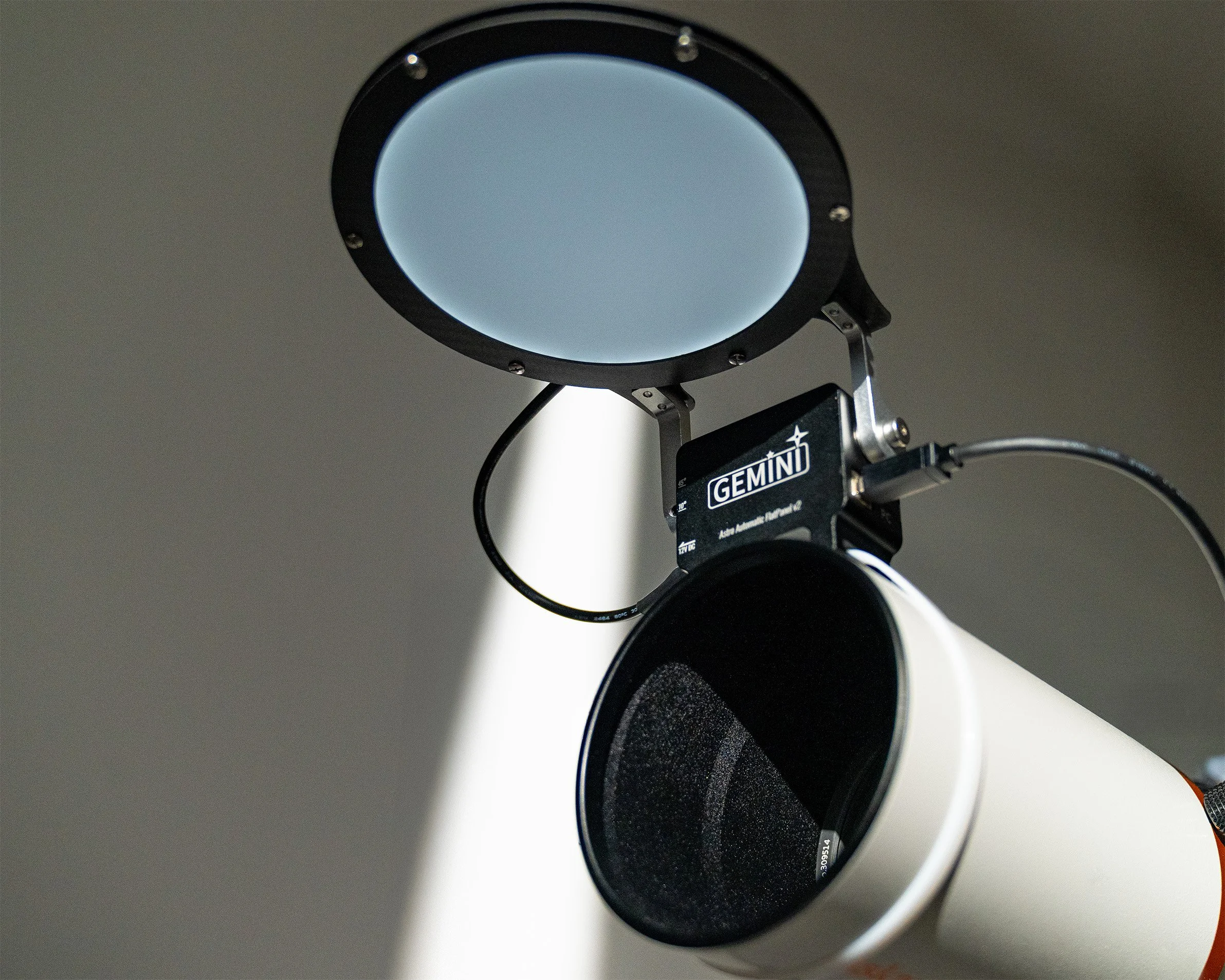
Gemini Motorised FlatPanel V2 boasts a flicker-free and bright panel.
As part of our ongoing series of astrophotography gear reviews focused on automation (something increasingly sought after by more advanced astrophotographers) we have been testing the Gemini Astro Automatic FlatPanel V2, a motorised flat panel designed to simplify and standardise the capture of calibration frames.
For this review, we used the 130 mm carbon fibre version. The panel is ASCOM compatible and can be controlled in multiple ways: via its included remote controller, through the dedicated GeminiFlatPanel app, or directly within popular imaging software such as NINA.
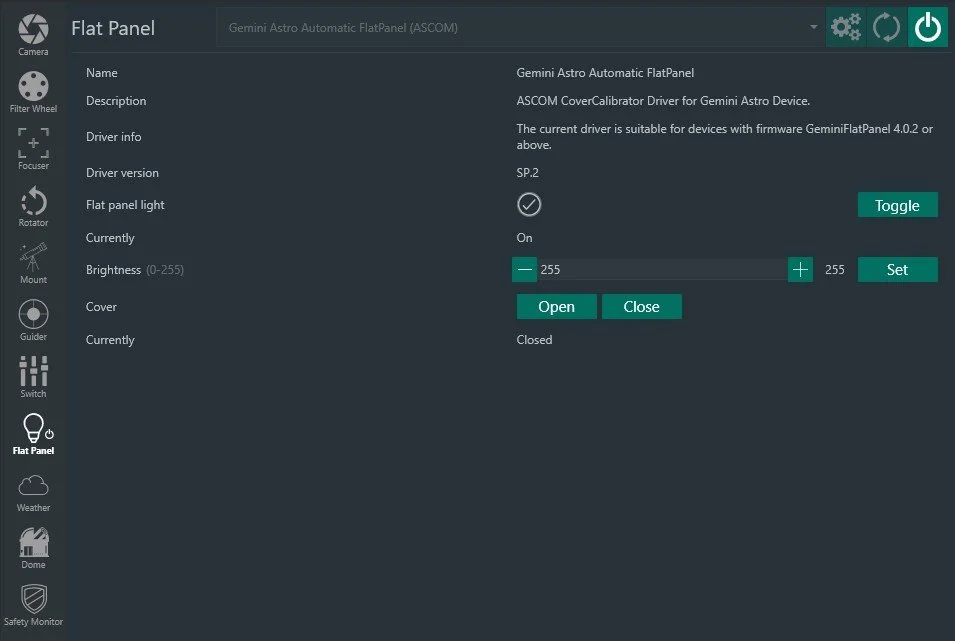
Thanks to its ASCOM compatibility, Gemini Motorised Flat Panel can be fully controlled via NINA
What is Flat Frame and why they matter in astrophotography?
A flat frame is one of the three core calibration frames used in astrophotography, alongside dark frames and bias frames. While darks and bias frames deal with sensor noise and readout artefacts, flat frames correct for optical imperfections in your imaging train. These include vignetting, uneven field illumination, dust shadows on the sensor or filters, and minor light fall-off caused by reducers, flatteners, or filters.
Without flat frames, these issues remain baked into your images. Vignetting becomes exaggerated when stretching the stacked image, dust motes turn into stubborn donut-shape rings, and gradients become harder to control in post-processing. Flat frames allow your stacking software to normalise illumination across the frame, ensuring that every pixel represents the true signal rather than the optical flaws.
“Flat frames are essential if you want clean backgrounds, consistent colour, and images that respond well to processing.”
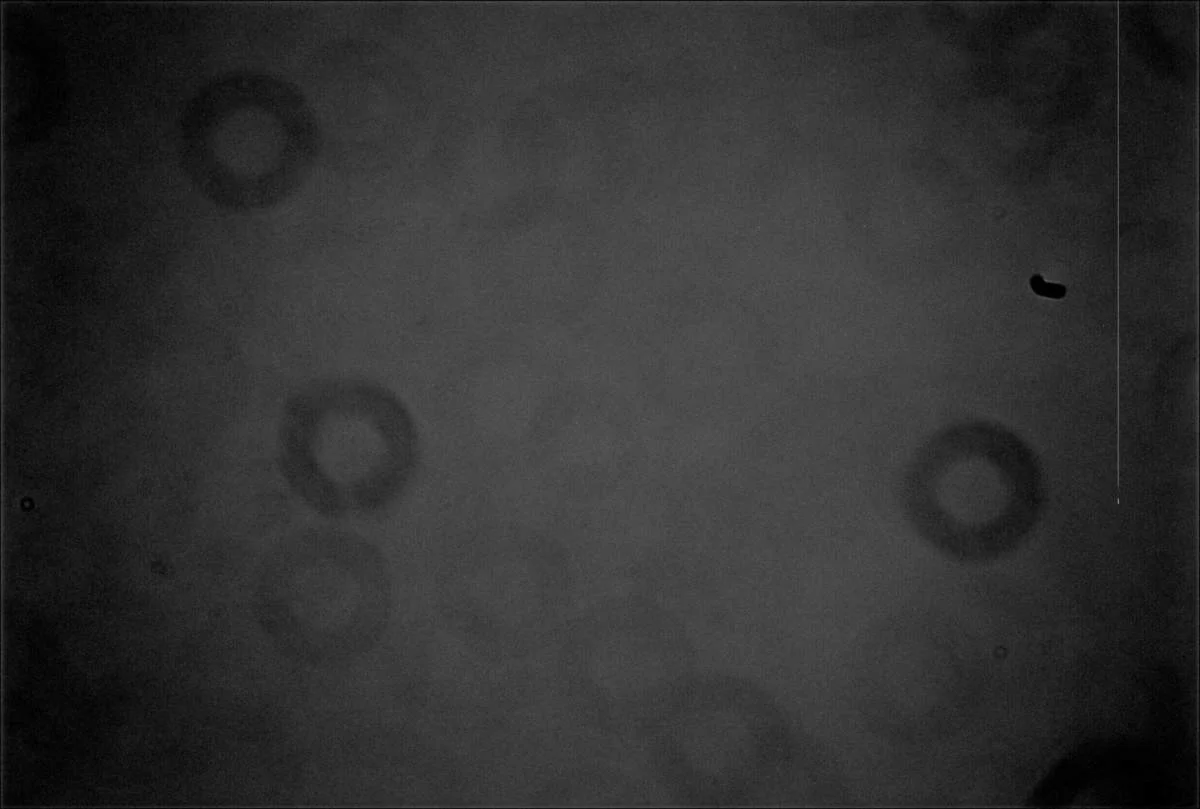
Flat frames help to remove dust shadows on the camera sensor, telescope lens/mirrors or filters.
What makes a good flat frame?
A good flat frame is defined by uniformity, consistency, and correct exposure. The light source must evenly illuminate the entire field of view without introducing gradients or hotspots. Any unevenness in the flat itself will be transferred into the calibrated image, doing more harm than good. This is why purpose-built electronic flat panels have become increasingly popular: they provide stable, repeatable illumination at a known colour temperature.
Exposure is equally critical. A flat frame should sit comfortably within the linear response range of your camera sensor, typically with the histogram peak around 30–50% (or roughly halfway) without clipping highlights or shadows.
Overexposed flats lose information, while underexposed flats fail to properly characterise vignetting and dust shadows. Just as importantly, flats must be captured without changing focus, camera rotation, or the optical configuration used for your light frames. Even small changes can invalidate them.
Ultimately, good flat frames are boring and that’s exactly the point. When done correctly, they disappear entirely from the final image, leaving behind smoother backgrounds, better colour balance, and data that is far easier to process.
“For serious astrophotographers, consistent flat calibration isn’t optional; it’s foundational.”
Calibration frames and how to take them:
-
Dark frames are used to remove thermal noise, hot pixels, and amp glow introduced by the camera sensor during long exposures. They are captured with the same exposure time, temperature, gain/ISO, and camera settings as your light frames, but with no light reaching the sensor. By subtracting dark frames during calibration, you eliminate sensor-specific noise patterns, resulting in cleaner data and smoother backgrounds.
-
Dark frames are used to remove thermal noise, hot pixels, and amp glow introduced by the camera sensor during long exposures. They are captured with the same exposure time, temperature, gain/ISO, and camera settings as your light frames, but with no light reaching the sensor. By subtracting dark frames during calibration, you eliminate sensor-specific noise patterns, resulting in cleaner data and smoother backgrounds.
-
Flat frames correct for optical issues in the imaging system rather than sensor noise. They remove vignetting, uneven field illumination, and dust shadows caused by particles on the sensor, filters, or optics. Flats are taken using a uniform light source without changing focus or the optical setup used for the light frames. Proper flat calibration ensures consistent illumination across the image and prevents these artefacts from becoming exaggerated during processing.
Gemini Motorised Flat Panel V2 Specs
The Gemini flat panel is available in a range of diameters, and it’s advisable to choose a model that is slightly larger than your telescope’s dew shield. This ensures even illumination across the entire aperture and avoids edge fall-off when capturing flat frames.
Power is supplied via an included USB cable as well as a 12V DC connector. In our testing, the panel functioned perfectly well even without the 12V connection, with the USB cable alone providing 5V power to operate the motor. This may be particularly appealing for portable setups or those looking to minimise cable clutter, though performance may vary depending on configuration.
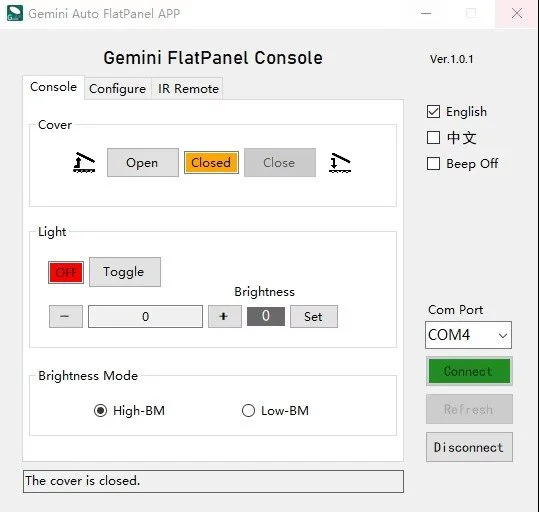
The Gemini FlatPanel Console app allows you to precisely determine by how much the panel opens and closes.
Brightness control is handled through 255 adjustable steps, allowing for very fine control over panel intensity. This makes it easy to dial in the correct exposure regardless of your optical train, camera sensitivity, or filter choice, and helps ensure consistently well-exposed flat frames across different imaging sessions. Paired with the Flat Wizard in NINA, taking flat frames becomes a breeze.
Top Specs:
Carbon fiber frame for the panel and aluminium motor enclosure.Remote control functionality.Flicker-free panel.Seamless alignment with telescope by using the Gemini FlatPanel Console.ASCOM compatible that works well with NINA and ZWO ASI Air.Quiet operation.
Gemini Astro’s motorise flat panel operates very quietly and smoothly.
Buying Experience via AliExpress
At the time of writing this review, we were unable to find any official retailers — at least in the UK — stocking the Gemini Astro motorised flat panels. As a result, the only viable purchasing route was via AliExpress. Naturally, this comes with a few considerations worth highlighting.
We ordered the panel directly from Gemini Astro’s official store on AliExpress. Communication was clear and responsive, and the team were happy to provide additional technical details prior to purchase. From placing the order to delivery in the UK, the process took just under two weeks, which is reasonable for shippings from China but not ideal if you’re working to a tight imaging schedule.
That said, buying through AliExpress does not always guarantee a smooth experience, and long-term after-sales support can be limited compared to established local retailers. For this reason, we generally recommend sourcing astrophotography equipment from trusted local astronomy retailers whenever possible. Not only does this support independent businesses within the community, but it also offers clearer consumer protections, faster delivery, and more reliable aftercare should issues arise.
If AliExpress is your only option, here are a few practical points to keep in mind:
Whenever possible, purchase from trusted retailers in your country.
Check store ratings on AliExpress and recent reviews carefully before ordering.
In a rush? AliExpress may not be for you.
Factor in import duties, VAT, and handling fees, which can significantly affect the final price.
Be prepared for limited post-purchase support compared to local specialist retailers.
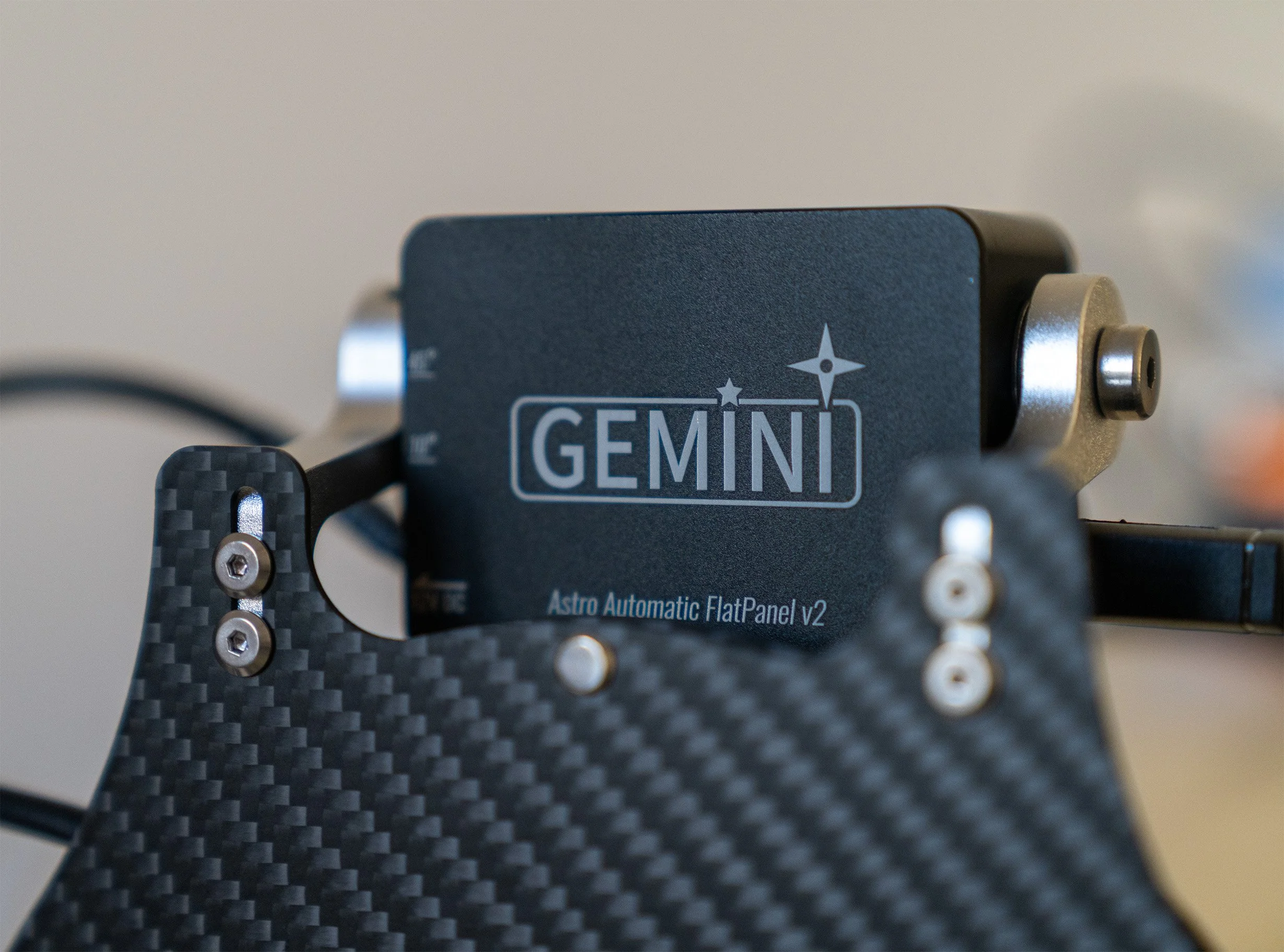
At the time of this review, Gemini Motorised Astro Panels are only available to purchase via AliExpress
Things we loved about this Flat Panel
Great build quality: The carbon fibre frame and the overall finish is made to last.
Fully adjustable and bright panel, perfect for narrowband filters.
The panel is flicker-free and is illuminated evently.
Solid performance overall and accurate Open and Close positions.
Things that could be improved
No manuals included. Also, the software installation isn’t streamlined and can be a little clunky.
The light panel has to be switched off via the software before disconnecting the device, otherwise it will stay on.
The Gemini Flat Panel App has a basic user interface. Hopefully it will get an update in the future.
No dedicated hard case for secure transportation.
And a couple of tiny nitpicks: no battery included with the remote control. Also, the included cable ties aren’t reusable.
Verdict:
Overall, the Gemini Automatic Flat Panel V2 is a highly accomplished piece of equipment that can significantly streamline an automated astrophotography workflow. Compared to many competitors, it offers strong value for money, with pricing starting at around $170 USD. Final cost will vary depending on the panel diameter you choose, your location, shipping fees, import duties, and whether Gemini Astro are running promotional offers at the time of purchase.
One important consideration relates to aftercare and warranty. The retailer currently provides a one-year limited warranty covering parts only, rather than the entire unit. While this is not unusual for niche astrophotography accessories sold direct-to-consumer, it is something prospective buyers should be aware of before committing, particularly when purchasing from overseas.
In practical use, this motorised flat panel adds a valuable layer of automation and convenience to any imaging setup, making the process of capturing calibration frames far quicker, more consistent, and far less intrusive at the end of a long imaging session. Build quality is solid, operation is reliable, and once the initial setup and configuration hurdles are overcome, the panel integrates smoothly into a modern, automated astrophotography workflow.
Looking ahead, Gemini Astro has the potential to become a key player in the flat panel market, particularly if they expand distribution and make their products more readily available through trusted local retailers in Europe, the US, and other regions. Wider availability would not only improve accessibility but also strengthen after-sales support — an area that remains important for serious astrophotographers investing in long-term equipment.
About Gemini Astro:
Gemini was founded in 2022 by several astrophotography enthusiasts in China. Their aim was to break the monopoly of high prices and make deep-sky photography accessible to all, not just a few. They made a start with the Gemini Automatic Astro Focuser. After that, they expanded the ecosystem with supporting tools like the Power & Data Hub and Motorized Flat Panel, gradually building a complete and affordable imaging system. Gemini Astro maintain their ambition to develop high-quality, reasonably-priced products.