PixInsight Through the Years: How the Astrophotography Landscape Is Changing
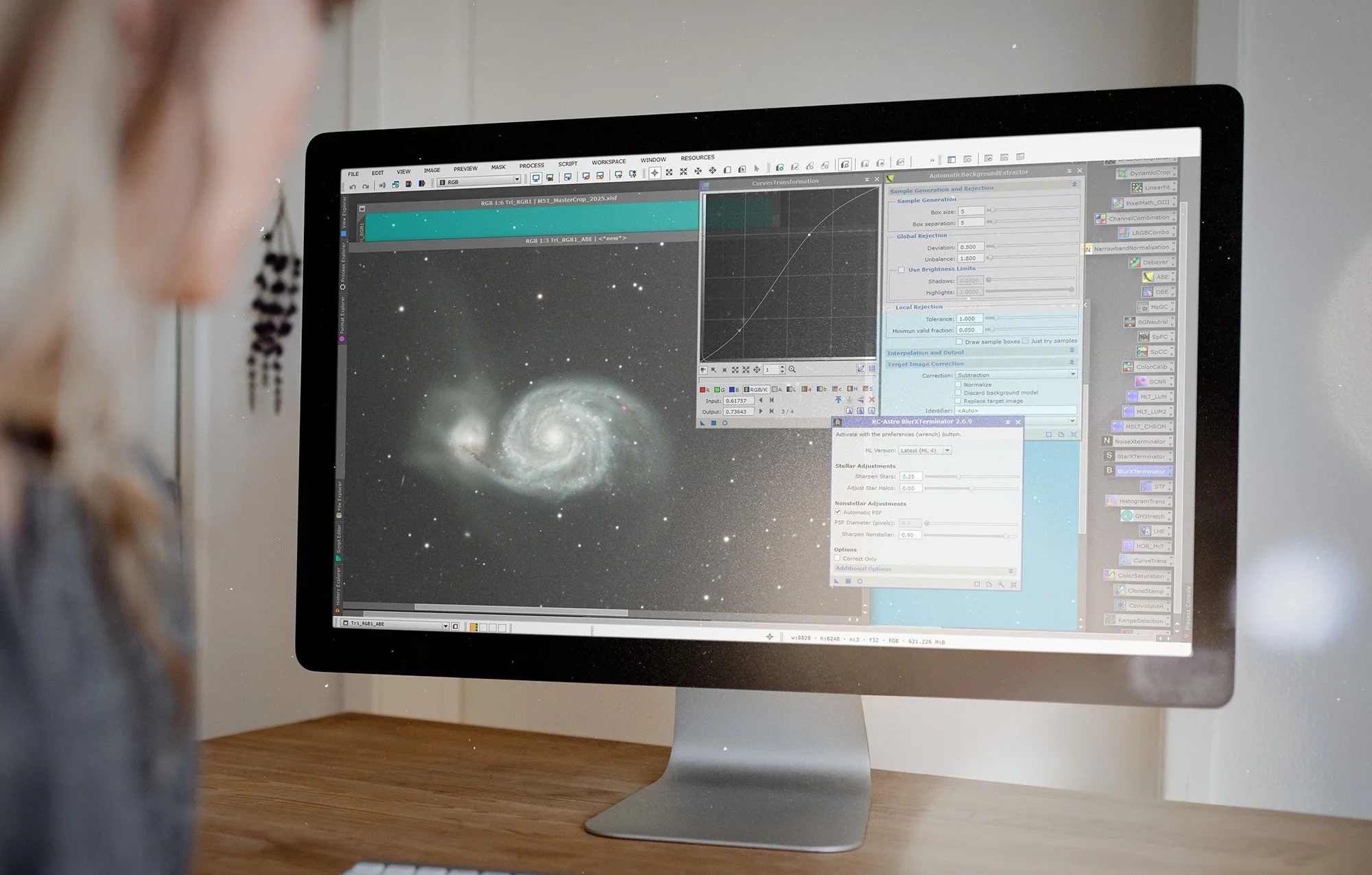
PixInsight released an open letter to its users on 03 October 2026.
Recent changes to PixInsight, growing competition and rumours surrounding some of its most popular third-party tools have sparked an unusually heated debate across the astrophotography community. PixInsight has now responded with an open letter of its own. Strip away the social-media noise, though, and the situation is more complicated than either side would have you believe.
If you have spent much time in astrophotography groups, forums or YouTube over the past few weeks, you will probably have seen some version of the same story. PixInsight might have unintentionally upset some users. Third-party developers are being pushed away. RC Astro and SetiAstro could be next. Some have gone further still, questioning whether the software that has dominated serious astrophotography processing for much of the past two decades is starting to lose its grip.
On 3 October, PixInsight SEO and principal developer Juan Conejero entered the debate directly, publishing an open letter to users after what he described as opinions and judgements about PixInsight’s work and history spreading through “influencer channels and public forums”. The letter is clearly frustrated in places, but its existence also tells us something important: the conversation has become loud enough that PixInsight felt it needed to respond publicly.
Some of what has been said deserves scrutiny. Some of it has been exaggerated. More importantly, underneath the rumours is a much more interesting development: PixInsight is now operating in an astrophotography software market that looks very different from the one it dominated even a few years ago.
“Recently, opinions and judgments about our work and our history have been circulating across various influencer channels and public forums—views that bear no relation to the reality of our team and our company. ”
The RC Astro and SetiAstro speculations
The most eye-catching claim currently circulating is that PixInsight may remove or restrict RC Astro and SetiAstro from its platform. Given how deeply tools such as BlurXTerminator, NoiseXTerminator and the various SetiAstro scripts have become embedded in many photographers’ workflows, it is easy to see why that idea travelled quickly.
There is, however, an important problem with it. At the time of writing this analysis, there is no public announcement from PixInsight, RC Astro or SetiAstro saying that either developer is being removed from the platform. Our tests and checks confirm that. In fact, the available evidence currently points in the opposite direction. RC Astro’s unified PixInsight suite explicitly supports PixInsight versions up to 1.9.5 and provides installation instructions for BlurXTerminator, NoiseXTerminator and StarXTerminator inside the latest version.
Seti Astro Suite Pro is a free astrophotography software
SetiAstro is still maintaining a dedicated PixInsight repository as well. Its own website continues to describe scripts developed specifically to make processing in PixInsight easier and provides repository addresses for current versions. There are a small number of older scripts that will not be ported, with those functions moving instead towards Seti Astro Suite Pro, but that is rather different from PixInsight throwing SetiAstro out.
What has happened is that recent PixInsight updates have caused disruption. When 1.9.5 arrived on 18 September, users reported SetiAstro scripts disappearing from their installations. A Reddit discussion from the day of the update captures the confusion rather neatly: users initially thought the scripts had vanished, only to report shortly afterwards that they had returned and were working again. That is consistent with a compatibility or repository problem. It is not, by any means, evidence of a ban.
RC Astro has had its own compatibility wrinkles. Older repository configurations no longer work with PixInsight 1.9.5, while changes to the CUDA and cuDNN libraries bundled with PixInsight have affected GPU acceleration on some older graphics hardware. These are genuine inconveniences, particularly for users who simply want an existing workflow to carry on working. But again, they are complex technical issues that are challenging to navigate, rather than proof of a deliberate attempt to remove RC Astro.
Why the rumours found an audience
It would also be unfair to dismiss the whole thing as people gossiping online. Rumours started circling when there is already a degree of mistrust, and PixInsight has made several decisions in recent years that have irritated parts of its own community.
The handling of the official PixInsight forum has been particularly contentious. Earlier this year the long-running user-support forum was dramatically reduced, with much of the traditional user-to-user discussion disappearing and the remaining areas becoming much more focused on development and bug reporting. For experienced users, that removed a substantial archive of knowledge. For newer users, it meant losing one of the places where somebody could explain why a process was behaving strangely without requiring them to hunt through Facebook groups, Discord servers or old tutorials. The reaction on Cloudy Nights (at least the ones that Astromaniac Magazine has come across) was at times hostile, but even allowing for the usual temperature of an internet forum, the frustration itself was clearly present.
There has also been debates over how competing software and third-party products are discussed within PixInsight’s own community. In 2024, PixInsight made clear that its forum would not permit discussion of competing products, a policy that some users regarded as unnecessarily restrictive, particularly when third-party tools were part of their PixInsight workflow. PixInsight has every right to decide what its own official infrastructure is used for, and expecting a company to provide a promotional platform for its competitors would be unreasonable. At the same time, modern astrophotography processing is increasingly built around several applications working together, so drawing a very hard line around that discussion can feel out of step with the way many photographers actually work.
Then came PixInsight 1.9.4 and one of the largest technical changes behind the scenes for years. The old SpiderMonkey JavaScript engine, which had powered PixInsight scripting since 2015, was replaced by a completely redesigned runtime based on Google’s V8 engine. From a development point of view this was significant and had been more than a year in the making. From a user’s point of view, the immediate consequence was much simpler: quite a few familiar scripts stopped working until they were ported.
None of this demonstrates that PixInsight wants to destroy its third-party ecosystem. It does explain why users were primed to interpret another missing script or repository problem as something more sinister. PixInsight cannot reasonably be blamed for every rumour posted on Reddit or every dramatic YouTube thumbnail, but its own communication and community decisions have helped create an environment in which those rumours travel unusually well.
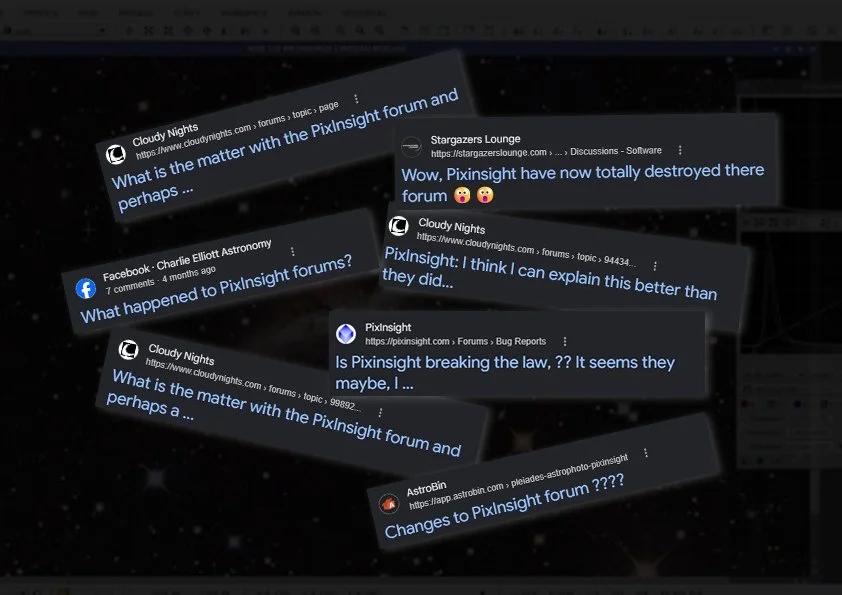
A snapshot of the debate surrounding PixInsight’s forum changes across astronomy communities and social media.
A much bigger change is happening
The more significant challenge to PixInsight has little to do with forum politics. For years, PixInsight occupied an unusual position in astrophotography. There were other processing applications, certainly, but once somebody became serious about deep-sky imaging, the conversation had a tendency to arrive at PixInsight sooner or later. It was expensive compared with free alternatives, its interface could be intimidating and the learning curve had become something of a running joke, yet the depth of the software made the investment difficult to argue against.
Then, Siril developed into a considerably more capable processing environment while remaining free. GraXpert has made sophisticated background extraction and machine-learning noise reduction remarkably accessible. SetiAstro has continued expanding both its PixInsight scripts and its own processing software. None of these applications needs to be declared a “PixInsight killer” to change the market; they simply need to become good enough that an astrophotographer no longer feels there is only one serious path available.
RC Astro may be the clearest example of how quickly that landscape is changing. BlurXTerminator, NoiseXTerminator and StarXTerminator became some of the most valued additions to a PixInsight workflow, to the point where for some users they became part of the reason to own PixInsight in the first place. During 2026, however, RC Astro released standalone versions of its tools and began integrating them with applications including Siril and Seti Astro Suite Pro. The company now maintains a common software base spanning its standalone and PixInsight versions.
An astrophotographer who wants BlurXTerminator is no longer automatically an astrophotographer who needs PixInsight. Once individual parts of a previously PixInsight-centred workflow become portable, the gravitational pull of the whole ecosystem becomes weaker. Not to mention that PixInsight’s interface and its price tag might put some astrophotographers off as well.
None of this means the alternatives have caught PixInsight in every respect. They have not. PixInsight remains an extraordinarily deep environment, particularly once image calibration, integration, masks, PixelMath, astrometry, colour calibration and its huge range of specialised processes are taken into account. Comparing it with one free application or a handful of standalone AI tools can become misleading very quickly.
But it is now being challenged in a way that feels more substantial than it did five years ago, and that is probably the real reason the current debate has struck a nerve. Plus, a lot of developers, software designers and astrophotographers are diving into astro software design with the use of AI services such as Codex and Claude AI which will inevitably make the competition more saturated.
PixInsight has hardly stopped developing
There is another awkward fact for the “PixInsight is dying” narrative: PixInsight is currently releasing quite a lot of software.
Version 1.9.5 arrived on 18 September as a major update, bringing the new MachineLearning module and MLDenoise, PixInsight’s own machine-learning noise reduction process. WeightedBatchPreprocessing 3.1.0 arrived alongside it, while builds 1705 and 1706 followed within weeks with further changes and maintenance work. PixInsight has also recently updated its XISF specification and continued work on tools such as MultiscaleAdaptiveStretch.
It is difficult to reconcile that level of development with claims that the project is somehow winding down. PixInsight’s developers may be making choices that some users dislike, and they may face stronger competition than before, but those are very different arguments from saying the platform is being abandoned.
MLDenoise is particularly interesting because it places PixInsight itself much more directly into an area where third-party developers have enjoyed enormous success. Comparisons with NoiseXTerminator were inevitable from the moment it appeared. That does not necessarily make the two products enemies, any more than the existence of several stretching algorithms means only one of them can survive, but it does make the relationship between PixInsight and its surrounding ecosystem more complicated than it once was.
Competition is now happening both outside PixInsight and inside it.
PixInsight deserves some historical perspective too

Juan Conejero, Co-Founder and CEO, Pleiades Astrophoto S.L.
It is easy, particularly online, to judge twenty years of work through the lens of whatever happened last Tuesday.
PixInsight began in 2003, following Juan Conejero’s earlier work on astronomical noise reduction, with the limited PixInsight LE appearing around 2004–05. Its original conception was unusually ambitious: not a general photo editor adapted for astronomy, but a modular image-processing environment built specifically around astronomical and scientific imaging.
The influence it has had on amateur astrophotography since then is difficult to overstate. Processes such as DynamicBackgroundExtraction, PixelMath, StarAlignment, sophisticated multiscale tools and later developments in image integration, photometric calibration and automated preprocessing have shaped not only how people process images but how astrophotographers talk about processing in the first place. Some techniques that are now taken for granted across the hobby were being developed and refined within PixInsight many years ago.
It also provided an environment in which independent developers could build tools of their own. The extraordinary popularity of RC Astro’s products within PixInsight is part of that story, rather than something entirely separate from it. The same is true of the large collection of scripts created by users and developers over the years.
That history does not place PixInsight beyond criticism. If anything, its importance makes decisions about interoperability, community support and third-party development more consequential. But writing the software off because Siril has improved, or because a developer has released a standalone version of a plug-in, would ignore how much of the modern astrophotography processing landscape PixInsight helped create.
And then there is YouTube
PixInsight’s open letter takes aim at some of the commentary circulating through influencer channels and public forums, and there is a legitimate point buried in the irritation. Online platforms reward certainty and conflict. “PixInsight updates its scripting engine and some developers need time to port their scripts” is accurate, but it is hardly irresistible YouTube material. A thumbnail asking whether PixInsight is finished is likely to perform rather better.
That does not mean criticism from YouTubers or other creators should be waved away as clickbait, not all of them anyway. Some of the underlying complaints are perfectly reasonable, particularly around the forum changes, interoperability and the disruption caused by recent updates. The useful dividing line is evidence. If PixInsight announces that RC Astro can no longer distribute its tools through the platform, that would be a major story. If a plug-in temporarily disappears after a software update and somebody concludes that PixInsight is preparing to ban its developer, that remains speculation until there is something more substantial behind it.
PixInsight should be held to the same standard. Describing criticism as something circulating among influencers does not make it wrong, and users who have invested years learning a complicated piece of software are entitled to question decisions that affect the way they work. The open letter is useful because it gives PixInsight’s side of the argument directly, but it does not automatically settle every criticism raised against the company.
This is where much of the debate has become unnecessarily tribal. You do not have to choose between believing that PixInsight can do no wrong and believing that it is months away from disappearing.
“Are we in decline? Are we finished? Are we witnessing the fall of PixInsight? Many would like it to be that way. Some would even pay for it to happen. Yet, the exact opposite is true.”
So where does PixInsight actually stand?
PixInsight isn’t going anywhere nor is its influence and contribution to astrophotography diminishing. There is currently no credible evidence that RC Astro or SetiAstro are about to be removed, and the pace of development around PixInsight 1.9.5 suggests a project that remains technically ambitious and very active.
What has changed is its position in the astrophotography community. Astrophotographers have more choices than they used to, some of the most desirable third-party tools are becoming independent of PixInsight, and users are increasingly comfortable moving an image between several applications rather than committing themselves to a single processing environment, especially when free or more affordable alternatives are available. That inevitably puts pressure on a platform whose strength has traditionally come partly from the sheer breadth of what could be done without leaving it.
PixInsight has also made life harder for itself at times. The way its community has been handled and the occasionally combative tone around competing software have generated resentment that did not need to be there. When technical problems then appear, as they inevitably will during major architectural changes, that background of mistrust makes the most dramatic explanation easier to believe.
Yet the other half of the story matters just as much. PixInsight has spent more than two decades pushing astronomical image processing forward and continues to do so. Its competitors are now pushing hard as well, and some of the developers who once depended on PixInsight have reached the point where they can build beyond it.
“For our part, the future of PixInsight has never been brighter, never so full of potential, never more exciting. Our platform is robust, stable, and elegant, featuring an exquisite design from the ground up and a philosophy of rigor and respect for nature that underpins every detail. We will keep building on this foundation. The result will be spectacular, including new tools and a few surprises that we hope will thrill you as much as they do us.”
For astrophotographers, that is probably a healthier situation than one application having the field largely to itself. The current noise will eventually pass. The more lasting story is that PixInsight now faces a broader and more credible competitive field, and what it does next will be much more interesting than the rumours surrounding it today.
You can read the full open letter by Juan Conejero here.