WandererBox PLUS V3: A 150g Powerhouse
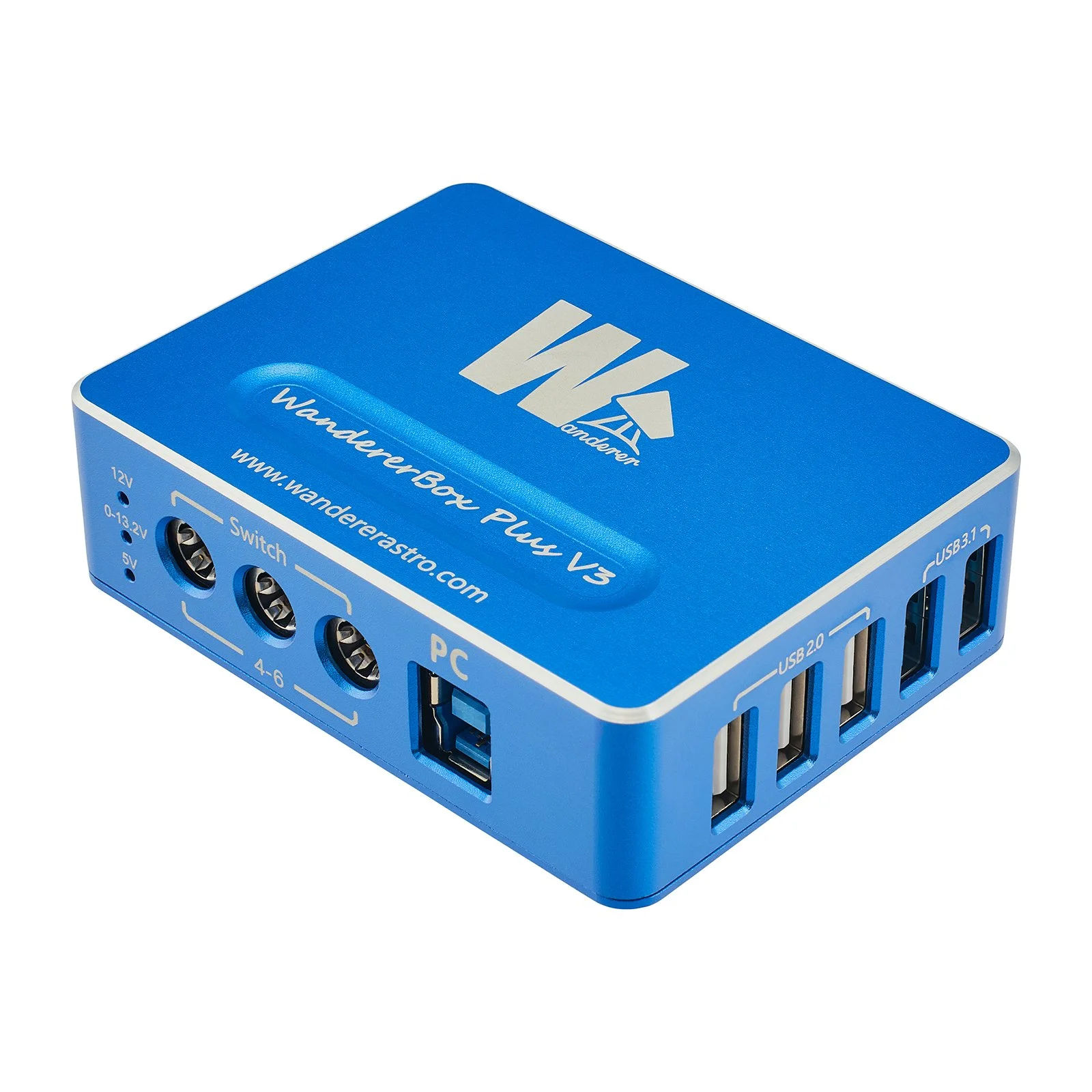
The WandererBox PLUS V3 is the mid-level astrophotography power controller by WandererAstro.
There are parts of an astrophotography rig we obsess over, and parts we only notice when they stop working. Cameras, telescopes and filters get the glamour. Power distribution, USB connectivity and dew control normally do not. Yet once an imaging setup grows beyond its simplest form, those less flashy components begin to determine whether the whole system behaves like one instrument or a collection of boxes held together by cables.
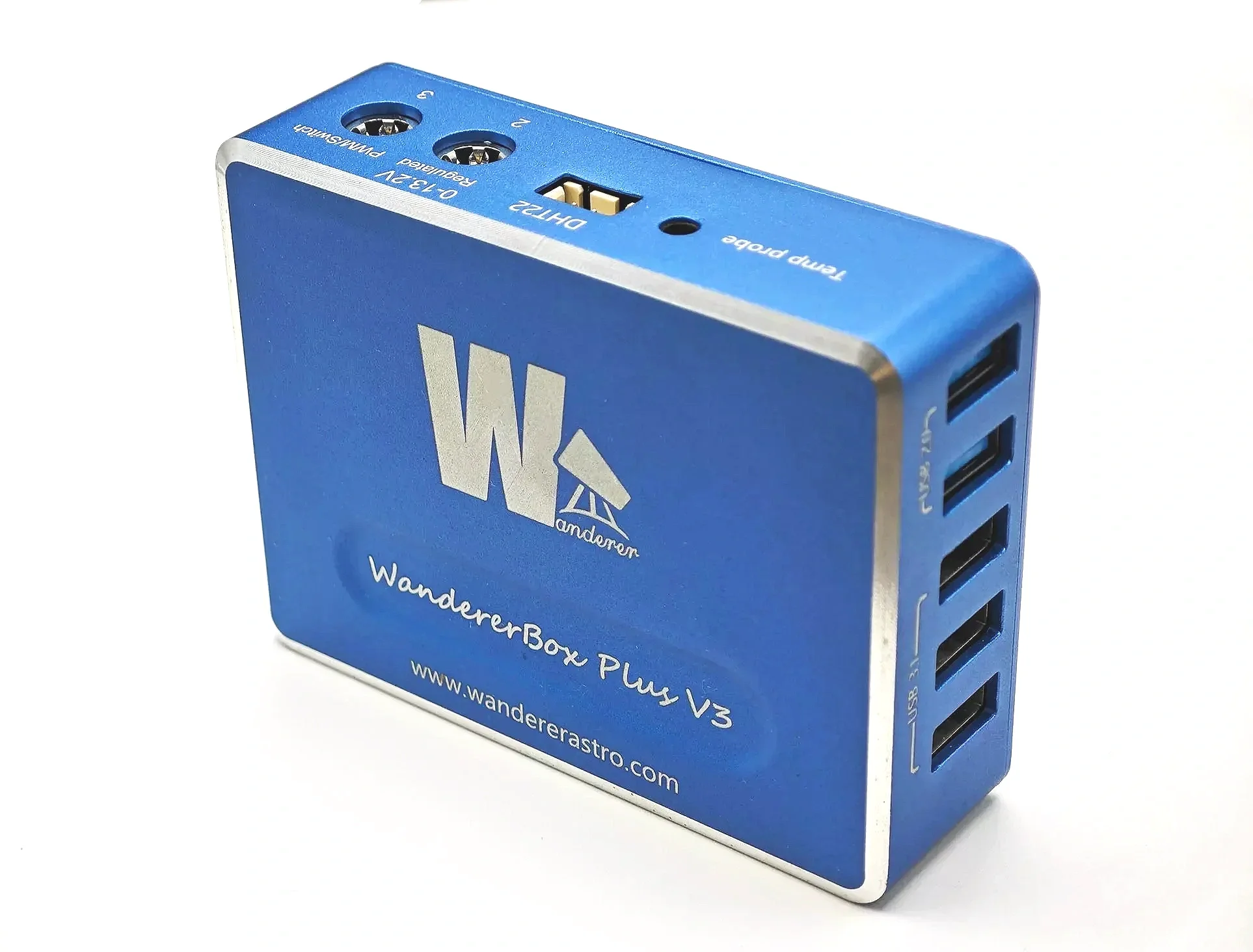
WandererBox PLUS V3
That is what makes the WandererBox PLUS V3 more compelling than its appearance suggests. At $299, WandererAstro’s compact astro power controller combines power distribution, a powered USB hub, environmental monitoring and intelligent dew control inside an 86 × 65 × 26mm enclosure weighing only 150g. Its job is to make everything around the telescope work with less intervention, and that places it squarely within one of the most important trends in modern astrophotography: automation.
In this WandererBox PLUS V3 review, we look beyond the ports and power ratings to ask where WandererAstro's 150g controller fits into an increasingly competitive generation of automated astrophotography power management.
Power controllers are becoming part of the telescope
It was not long ago that power management meant a large 12V supply on the ground, several cigarette-lighter adapters and enough Velcro to make the setup vaguely respectable. USB cables then ran separately back to the laptop, while dew heaters had their own controller somewhere else again. It worked, but every additional connection created another cable capable of snagging, disconnecting or failing halfway through the night.
Moving power and USB distribution onto the telescope changes that architecture. Instead of five or six cables travelling between the moving telescope and the stationary world below it, much of the system can terminate at a small hub attached to the optical tube or dovetail. One power cable and one data connection can then carry most of the burden. More importantly, a computer can monitor voltage, switch equipment on and off, regulate heaters and potentially recover a device without anyone touching the rig.
That distinction is particularly important for remote astrophotography. A power controller is not simply a neater extension lead. The ability to turn equipment off and back on from software can rescue a session when a camera, focuser or USB device stops responding. In that sense, products such as the WandererBox, Pegasus Powerbox and SVBONY SV241 Pro are gradually becoming the electrical nervous system of an automated imaging rig.
WandererAstro and the pursuit of automation
The PLUS V3 also makes more sense when viewed alongside WandererAstro’s wider catalogue. We have already reviewed the WandererRotator Mini V2 camera angle rotator and WandererCover V4-EC motorised flat panel. Neither aims to improve a telescope’s optics. Instead, each removes another task that would otherwise require the astrophotographer to intervene manually. The WandererBox PLUS V3 takes the same idea and applies it to power, connectivity and dew management.
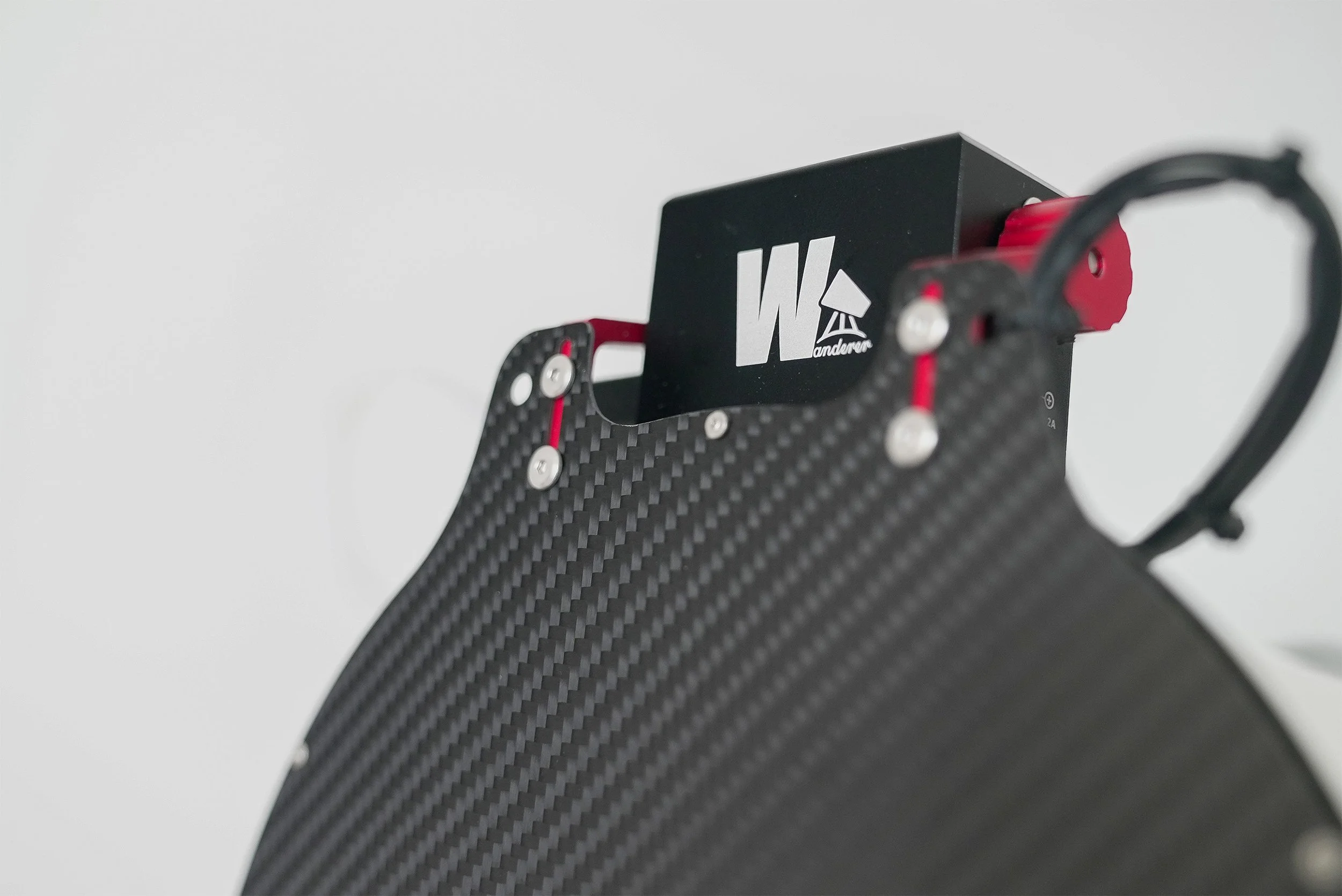
WandererAstro has a growing range of astrophotography equipment centred on automation.
That wider movement is something we find genuinely exciting. Astrophotography is becoming less about manually operating individual components and more about designing a system in which those components cooperate. The interesting question is no longer simply whether an accessory works, but how intelligently it integrates into the rest of the imaging workflow. The goal is to simplify a complicated workflow, so we can focus on gathering better data.
What exactly does the WandererBox PLUS V3 do?
The WandererBox PLUS V3 takes a 12V input through a 5.5 × 2.5mm connector and provides several different types of output rather than simply duplicating that incoming power. Its job is to intelligently distribute power between all your gear’s components, monitor the power input and output. But there is more.
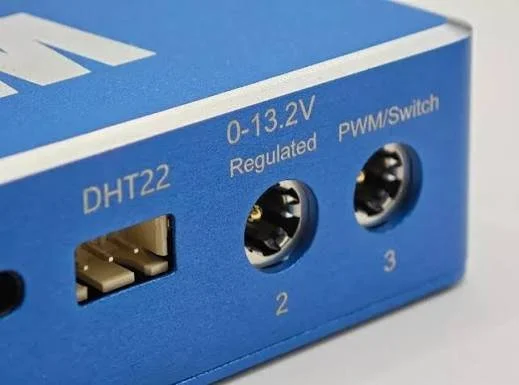
WandererBox Plus V3 benefits from 5-13.2V adjustable regulator, ensuring stable power supply.
There is one always-on output connected directly to the input, a switchable regulated output adjustable between 5V and 13.2V, one PWM output that can operate a dew heater or act as another switch, and three further 12V outputs controlled together. On the data side, there are two USB 3.1 and three USB 2.0 ports, sharing a 5V/5A supply and switched together through software.
That regulated output is more useful than it initially sounds. Voltage can fall along long power cables, and remote observatories do not always enjoy perfectly stable supplies. The PLUS V3 can maintain a set output voltage despite variation on the input side, something WandererAstro specifically highlights for cooled astronomy cameras and other voltage-sensitive equipment. It can also provide the lower voltages required by devices such as DSLR dummy batteries.
There is one detail worth flagging because the documentation is not entirely consistent. WandererAstro’s current product page rates the adjustable output at up to 5A, while an earlier manual lists a 3A maximum. The current 5A specification should therefore be treated as the operating limit unless WandererAstro advises otherwise.
We did initially experience some power instability when using an unsuitable supply. Once paired with a suitable 12V, 10A source through the WandererBox’s DC5525 input, the system operated reliably during our testing. WandererAstro don't recommend using 5521 adapters because a 5521 connector cannot carry a large current like a 5525 connector. They do provide 5521 to 5525 converters but that is meant to be a temporary solution for users who don't have 5525 power adapters on hand.
But the headline is clear: for something capable of replacing several separate accessories, 150g is impressively light.
A capable environmental monitoring mechanism
A dew heater is an unavoidable part of astrophotography. Apply enough heat to the telescope and condensation disappears. Apply far more heat than necessary and you waste power, while potentially creating unwanted thermal effects around the optics.
The WandererBox PLUS V3 includes both a DHT22 temperature and humidity sensor and a separate temperature probe. From those readings it can calculate dew point and operate its heater output in three ways: conventional manual PWM control, constant-temperature control, or a dew-point differential mode. In the latter, the controller attempts to maintain the heated surface a chosen amount above the calculated dew point rather than simply running the heater at a fixed percentage all night.
That is one of the strongest ideas in the product. Automatic dew control is not unique to WandererAstro, but it represents precisely the kind of small automation that makes an unattended setup more intelligent. Instead of asking the astrophotographer to predict how much heating the night will require, the system can respond as temperature and humidity change.
There is, however, only one independently controlled heater channel on the WandererBox PLUS V3. For a telescope with a single main dew strap that may be perfectly adequate. Add a guide scope, secondary heater or other independently regulated loads and the limits of the PLUS model appear quickly.
WandererEmpire & N.I.N.A.: More important than the box itself
Hardware like this ultimately lives or dies by software. WandererEmpire has improved considerably since WandererAstro’s earlier products, and the current WandererEmpire 2 integrates ASCOM directly rather than functioning as an isolated control application. WandererAstro currently distributes version 2.4.3 and lists compatibility with ASCOM 6 and 7, N.I.N.A. and Sequence Generator Pro, alongside an ASCOM Observing Conditions driver that exposes temperature and humidity information from the WandererBox.
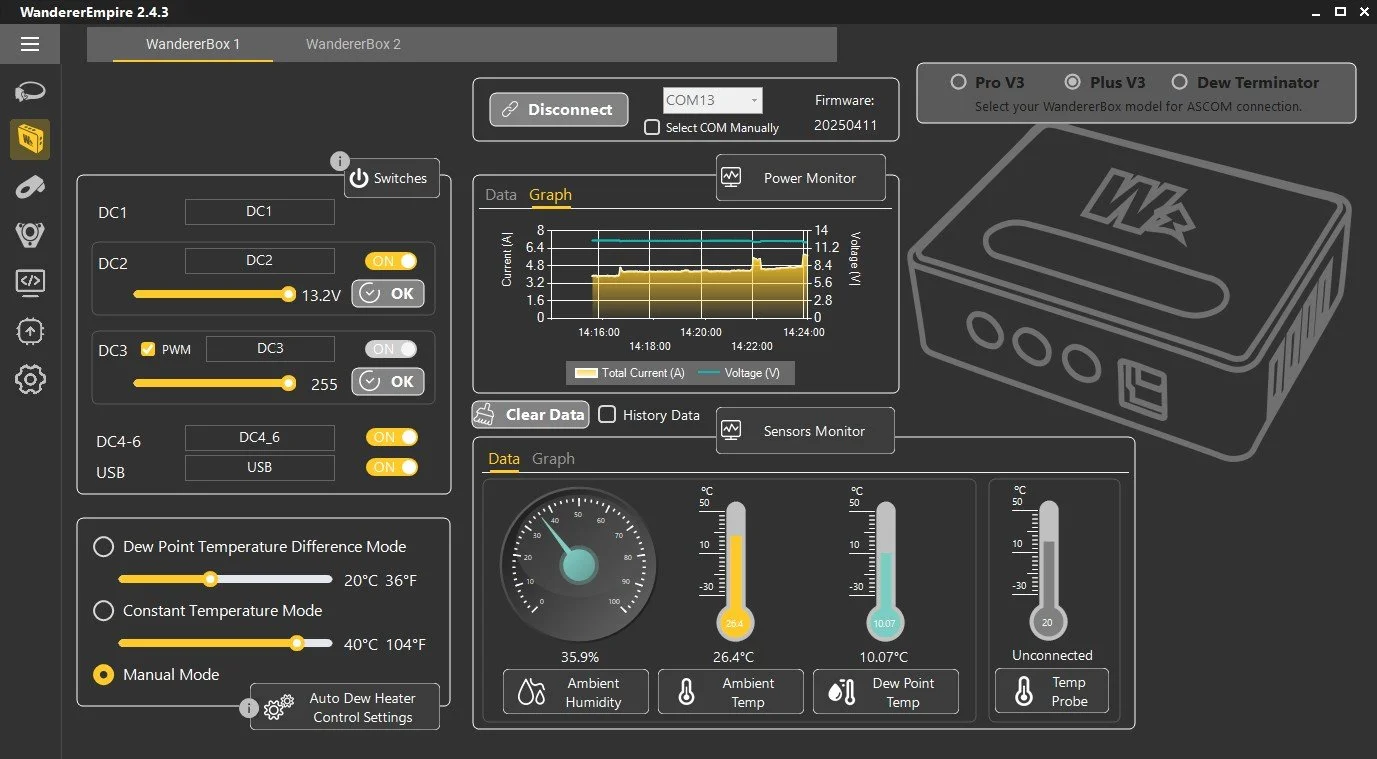
WandererEmpire 2 brings WandererAstro’s hardware together within a single control environment.
The WandererBox PLUS V3 can consequently appear inside N.I.N.A. as an ASCOM switch device. Power outputs, USB switching and customised port names can be controlled from there, with changes synchronised between N.I.N.A. and WandererEmpire. For an automated sequence, that is far more meaningful than having another pretty dashboard open on the desktop.
This is increasingly how we think astro power controllers should be judged. The best controller is not necessarily the one with the largest number of sockets. It is the one that works seamlessly across hardware and software.
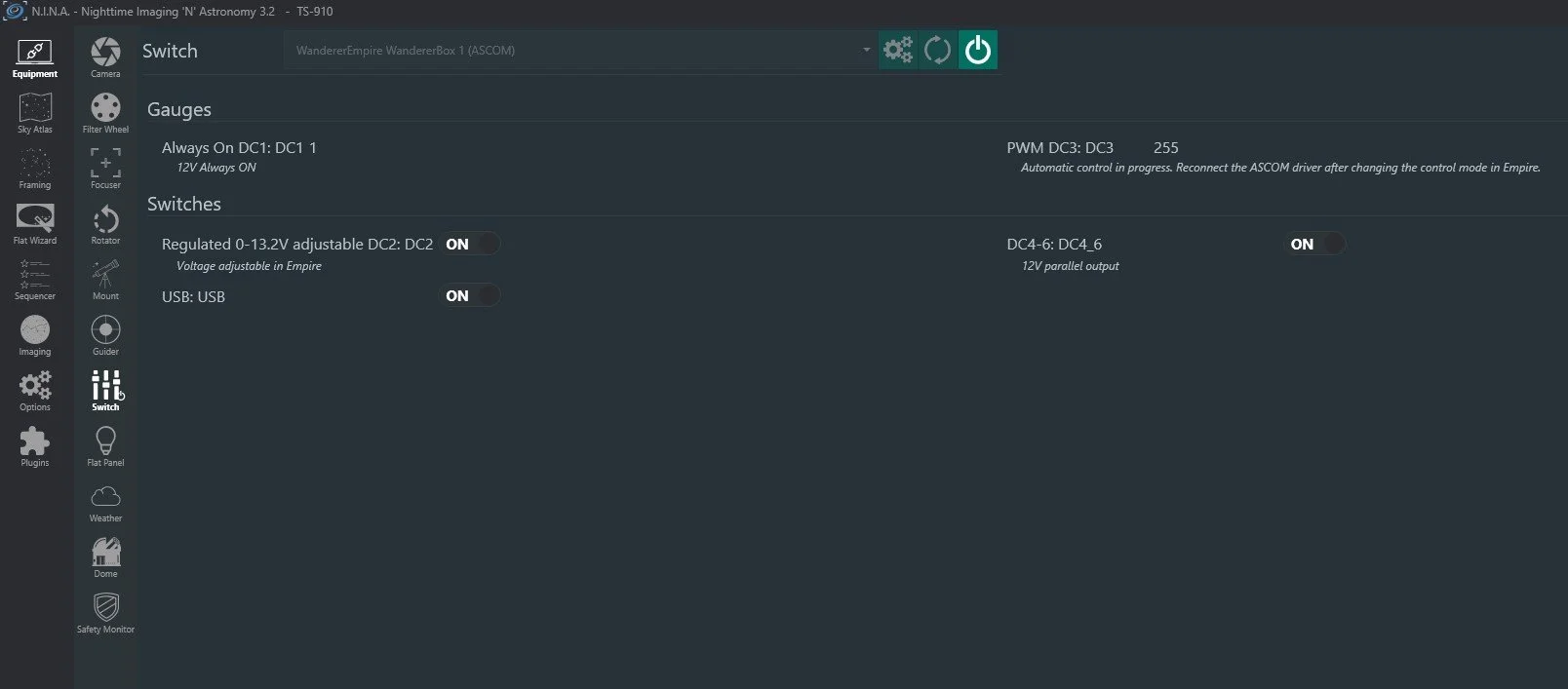
Thanks to the ASCOM integration, WandererBox PLUS V3 works seamlessly with NINA.
Where the PLUS V3 is less convincing
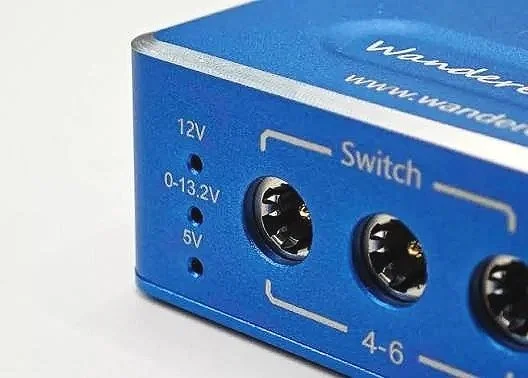
The three switched DC outputs provide 12V with a combined maximum output of 8A.
The main compromise is control granularity. The three ordinary 12V outputs are switched as one group, while all five USB ports are also switched together. If one USB device needs to be power-cycled remotely, you cannot simply restart that port without interrupting the other USB devices attached to the hub. That is not unusual at this price level, but it is important for remote setups. Understandably, every extra independently switched channel requires more electronics, more thermal headroom and ultimately more cost and size.
The connector choices may also require a little thought. Wanderer uses a 5.5 × 2.5mm input and the same size for the always-on output, whereas 5.5 × 2.1mm connectors remain extremely common across astronomy equipment. Wanderer does supply adapters through some packages and retailers, but this is still the kind of tiny inconvenience that can become disproportionately irritating when building a clean permanent rig. A dedicated RCA heater socket would also be more familiar to many astrophotographers, although using a standard DC socket allows Wanderer to make that output serve double duty as a normal switch.
What we loved about the WandererBox PLUS V3:
A wide range of ports and connections
Incredibly lightweight and small. Yet it packs a punch.
The dedicated software WandererEmpire 2 brings multiple WandererAstro devices together within one app.
What we’d like to see improved in future versions:

Wanderer Vixen Dovetail Bracket Kit For WandererBox
The cable lengths are slightly confusing. The PC cable is too short (0.5m) whilst both the temperature and humidity cables are inconveniently long.
The Vixen plate base is not included in the box. WandererAstro recommends a Vixen Dovetail Bracket which costs an extra £32-£35.
The Always On port uses a DC5525 (5.5 × 2.5mm) connector rather than the more common DC5521 used by many astronomy equipment.
Albeit included, the PWM dew cable requires an adapter (DC5521 to RCA adapter cable). That’s an unnecessary component that could go missing.
WandererBox PLUS V3 vs Pegasus Pocket Powerbox Advance Gen2
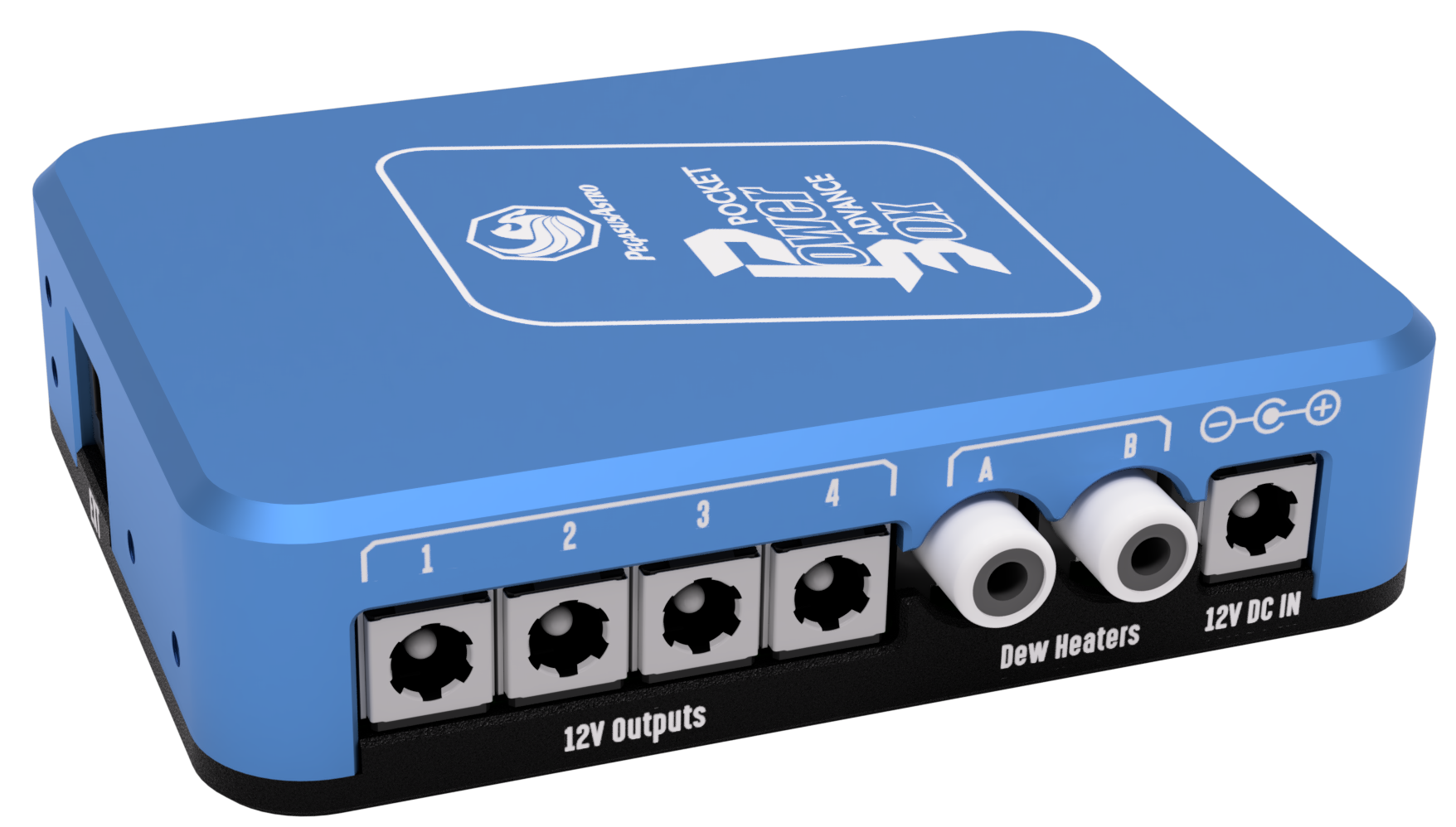
Pegasus Astro remains one of the reference names in this category, and its Pocket Powerbox Advance Gen2 is perhaps the most obvious established rival. It offers four 12V outputs, two independent PWM dew-heater channels, an adjustable 3–12V output and a four-port powered USB data hub, alongside a separate high-current 5V USB power output. Pegasus Unity is also a mature ecosystem with ASCOM, INDI and a documented API.
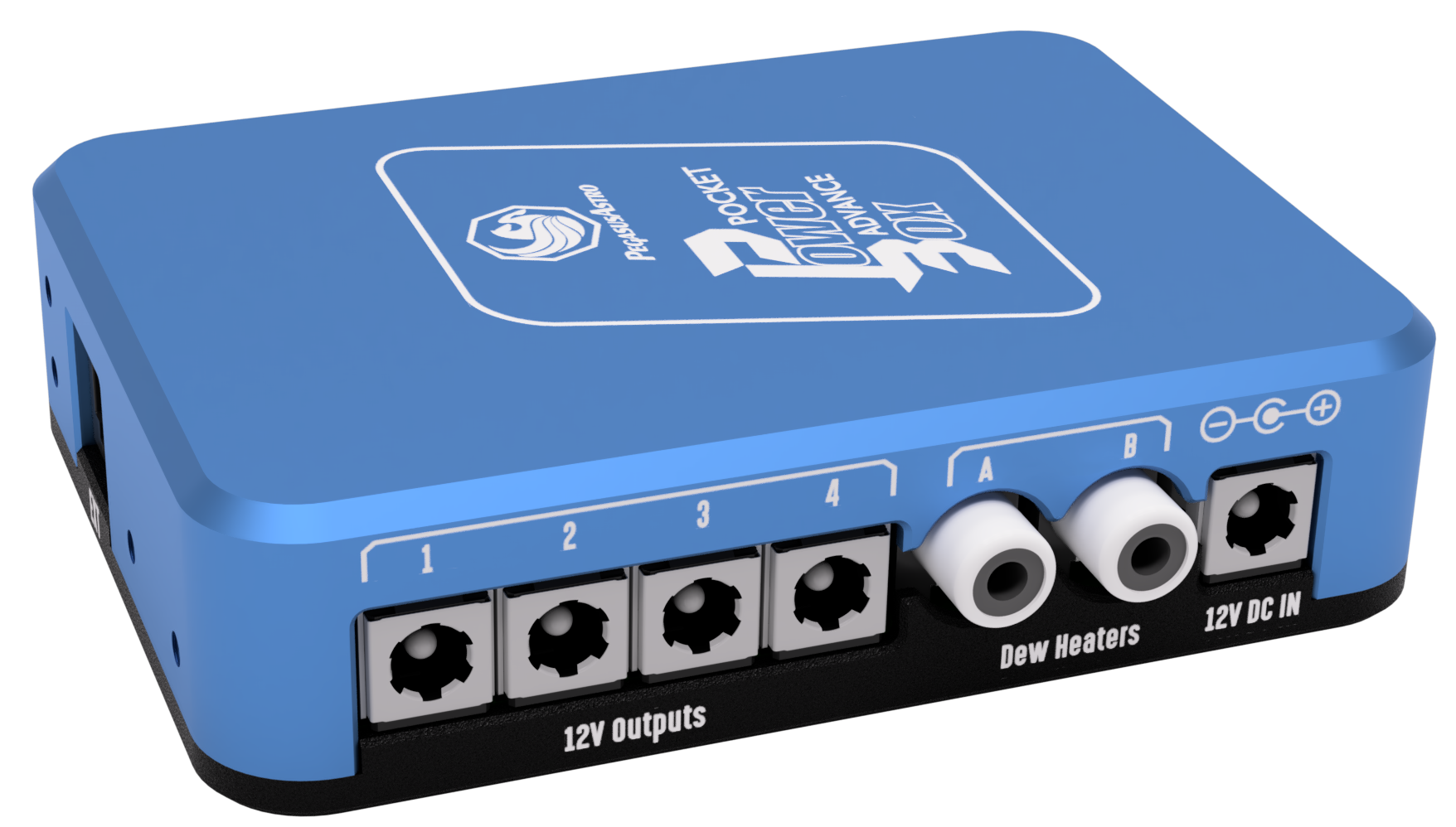
Like the WandererBox PLUS V3, the Pocket Powerbox Advance Gen2 by Pegasus Astro represents their mid-range power controller for astrophotography.
The comparison is more nuanced than simply counting sockets. Pegasus gives you two native heater channels, which can be preferable for a telescope and guide scope, while the WandererBox PLUS V3 provides only one. The Wanderer is significantly lighter at 150g versus 250g, is physically smaller, and its regulated output reaches 13.2V rather than Pegasus’s selectable 12V maximum.
Pegasus still has the advantage of a long-established software ecosystem. Wanderer’s argument is that its hardware combines a lot of functionality into an exceptionally compact package, and WandererEmpire 2 has closed much of the software gap.
And then there is the SVBONY SV241 Pro
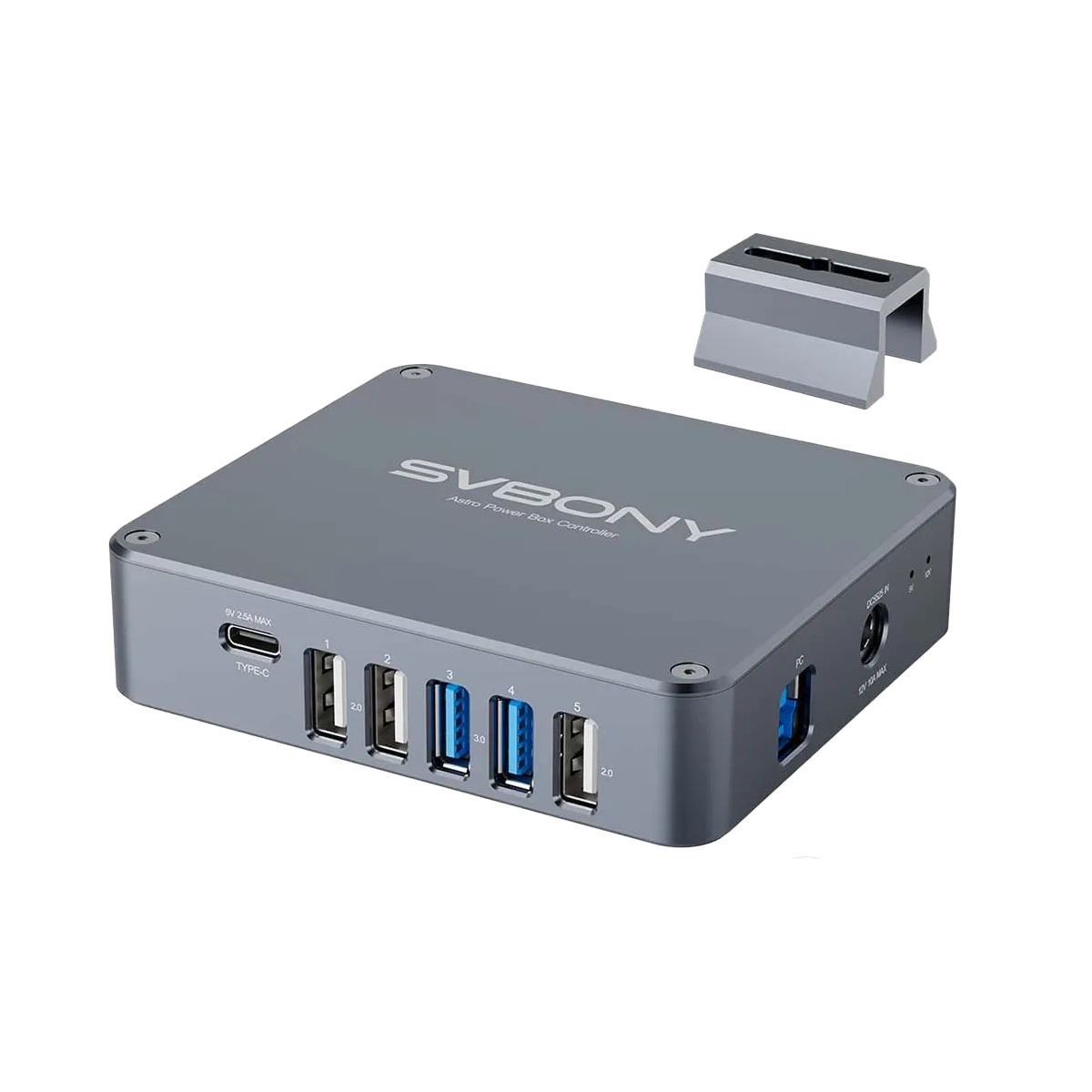
The SV241 Pro changes the conversation because it attacks this category aggressively on functionality and price. It provides more power outputs, two dew channels, six USB connections, environmental monitoring, adjustable voltage and direct ASCOM/N.I.N.A. integration. Its individual switching arrangements are also more flexible in several areas than the WandererBox PLUS V3 and it costs half the price.
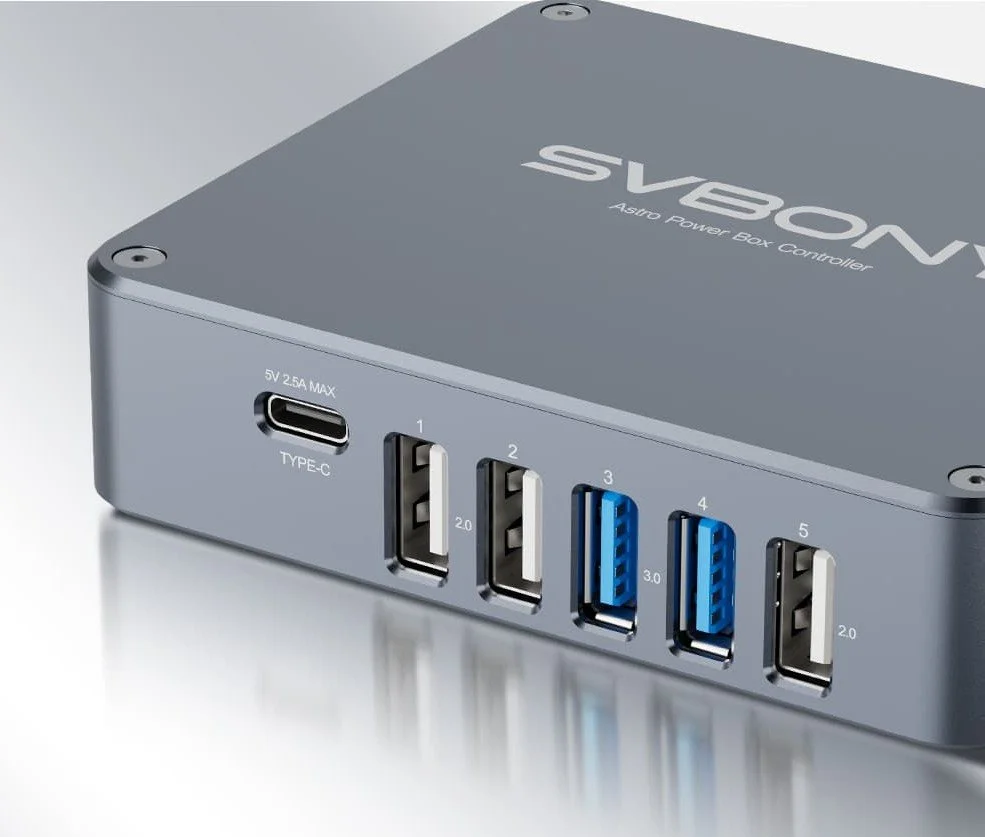
SVBONY SV241 Pro offers a generous range of ports.
We have already reviewed the SV241 Pro in depth, and it demonstrates how competitive astro power management has become. Its hardware specification is remarkably generous, although our broader view of that product remains that software polish and long-term confidence matter just as much as the number of ports printed on the enclosure. This is where the SV241 Pro falls short. Its Hub Control Manager software remains relatively basic and, in our experience, considerably less polished than either WandererEmpire 2 or Pegasus Unity.
That leaves the WandererBox PLUS V3 in an interesting middle ground. Pegasus has the strongest legacy and ecosystem. SVBONY pushes extremely hard on value. Wanderer concentrates on compactness, intelligent dew control and integration with their expanding family of automation accessories. There is no longer an obvious universal winner, which is actually good news for astrophotographers.
| Feature |

WandererBox PLUS V3
WandererAstro
|
SV241 Pro
Svbony
|
Pocket Powerbox Advance
Pegasus Astro
|
|---|---|---|---|
| DC power | 6 outputs Always-on, regulated, PWM and grouped switched outputs | 7 DC outputs Strong individual switching + regulated output | 4 × 12V + regulated Main 12V outputs switched as one group |
| USB | 5 ports 2 × USB 3.1 + 3 × USB 2.0 | 6 ports 2 × USB 3 + 3 × USB 2 + USB-C | 4 ports 2 × USB 3 + 2 × USB 2 |
| Dew control | 1 intelligent PWM channel Dedicated temperature probe + dew-point control | 2 PWM heater outputs Dedicated temperature probe + dew-point control | 2 PWM heater outputs One Temperature/dew sensor with RJ12 Socket |
| Monitoring | Voltage, current, temperature, humidity, dew point + temperature probe | Voltage, current, temperature, humidity, dew point + temperature probe | Detailed voltage/current monitoring + temperature, humidity and dew point |
| Dedicated Software | WandererEmpire | Hub Control Manager | Pegasus Unity |
| Size & weight | 86 × 65 × 26mm 150g | 100.5 × 87.5 × 24.5mm 210g | 100 × 71 × 24mm 250g |
| Best for | Compact & light Smallest and lightest of the three | Maximum value & versatility Lots of independently controlled connectivity | Established ecosystem Stable software and reliable |
| price | £289 | £149.99 | £259 |
Should you buy the WandererBox Pro V3 instead?
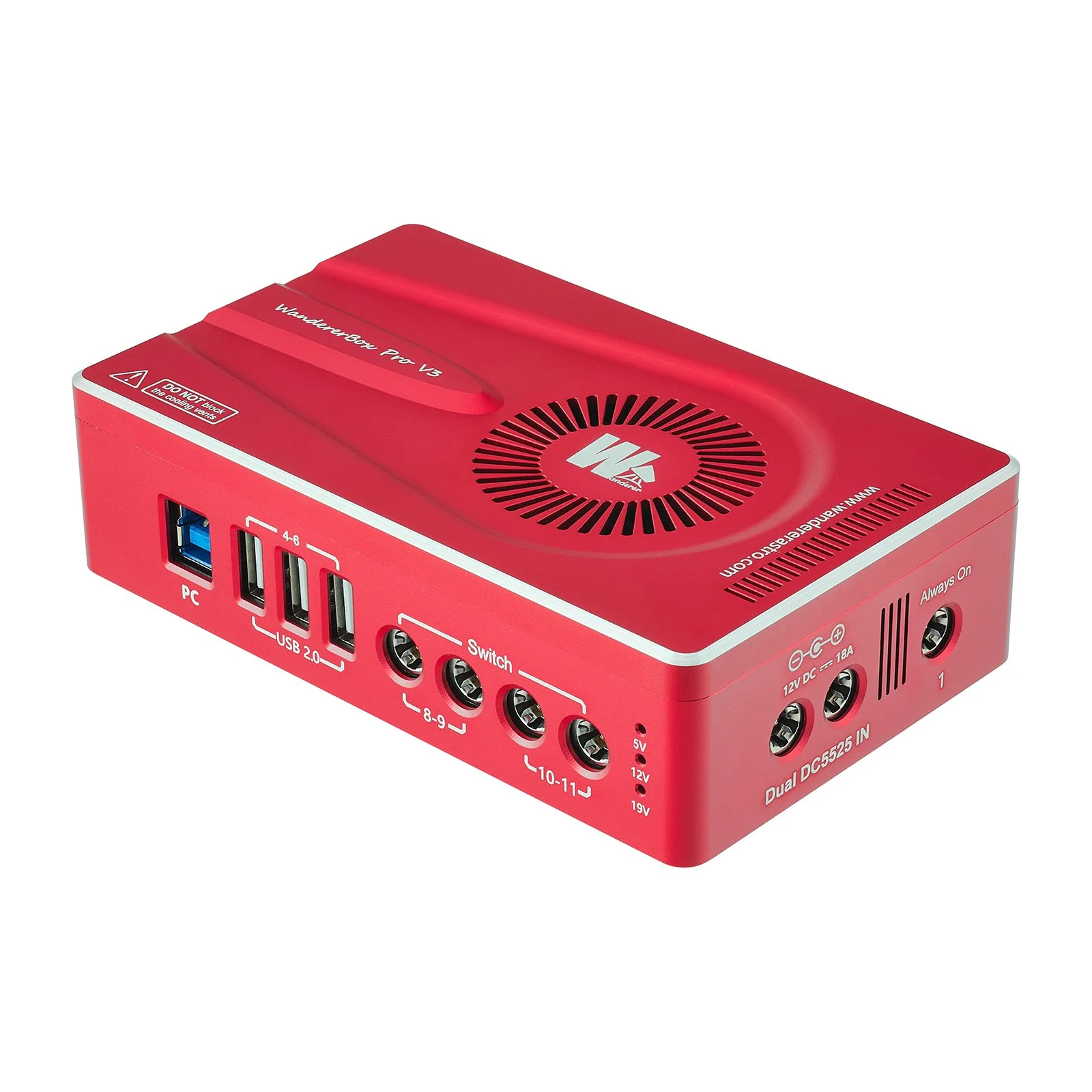
For more demanding setups, WandererBox Pro V3 provides a mini PC-like experience.
For a conventional portable imaging rig, the PLUS V3 makes sense. Once the setup becomes an observatory, or begins collecting multiple heaters, cameras and a dedicated mini PC, the WandererBox Pro V3 becomes considerably more compelling.
At $469, the WandererBox Pro V3 expands the architecture to ten power outputs and nine USB ports. Its three USB 3.1 ports can be switched individually, there are three independently controlled dew-heater channels, two adjustable regulated outputs, a dedicated 19V/6A output intended for mini PCs, and a much larger 18A maximum input. WandererAstro also adds active cooling for high-load operation.
The WandererBox PLUS V3 is therefore not simply a cheaper Pro. It is aimed at a different scale of system. The PLUS is easier to justify on a lightweight telescope where size and mass matter; the Pro is the more convincing architecture for an installation where remote recovery and independent control matter more than saving a few centimetres and grams.
Buying advice
WandererAstro explicitly warns that products bought through unauthorised AliExpress may be locked and excluded from warranty and after-sales support. The company publishes a distributor list and also sells directly.
For that reason, we strongly recommend buying a WandererBox directly from WandererAstro or from a trusted local astronomy retailer. If you are based in the UK, you can purchase the WandererBox PLUS V3 from here.
It’s also important to pair the power box with the suitable power supply that fits the 2.5 input port. Using an adapter to use your existing 2.1mm power supply is not advised as 2.1mm connectors can’t feed sufficient current to the power box.
Verdict: another sign of where astrophotography is going
At $299 WandererBox PLUS V3 faces very strong competition, its grouped USB and DC switching limits some remote-control scenarios, and anyone with several dew heaters or a complex observatory will probably find the WandererBox Pro V3 more appropriate.
But concentrating only on those criticisms misses what the PLUS V3 does particularly well. It weighs 150g yet combines regulated power, USB distribution, monitoring, intelligent dew control and genuine N.I.N.A./ASCOM integration. More importantly, it belongs to a rapidly evolving class of accessories that are turning astrophotography rigs from collections of individual devices into integrated systems.
That is also where WandererAstro is becoming interesting as a brand. The WandererRotator automates framing. The WandererCover automates flats and telescope protection. The WandererBox deals with power, connectivity and dew. None of them is the headline component of an imaging rig, yet together they address the repetitive jobs that determine whether automated astrophotography really feels automated.
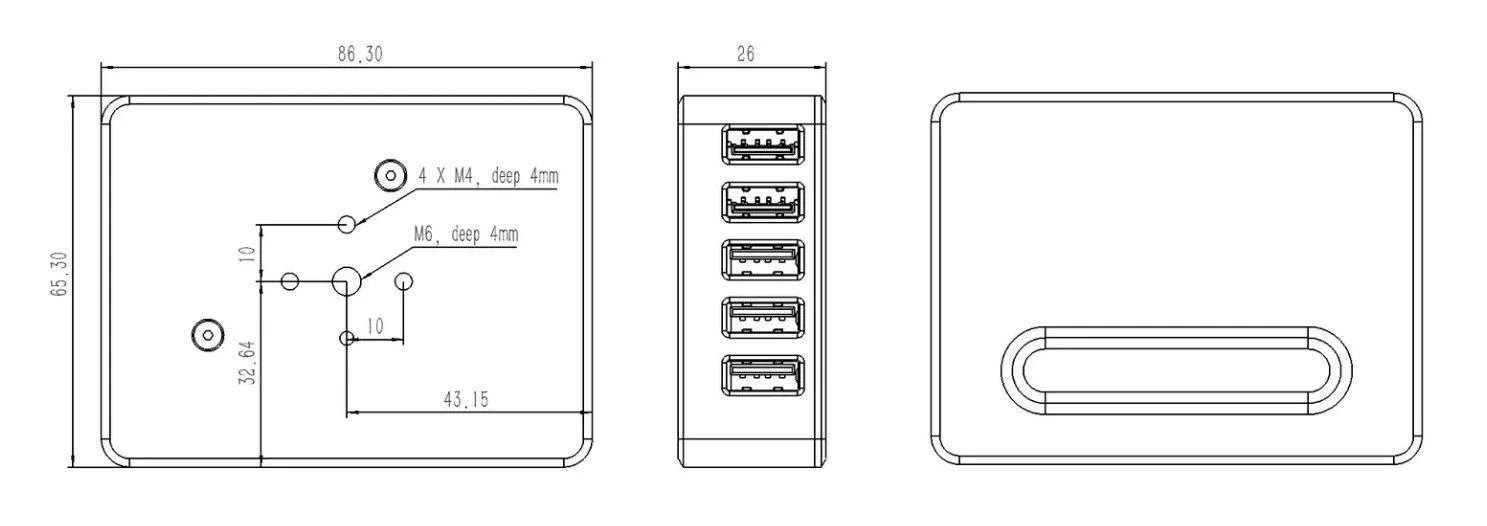
WandererBox PLUS V3 is astonishingly light and compact.
The WandererBox PLUS V3 would not be our automatic recommendation for every astrophotographer. That is precisely why the category has become worth paying attention to. Pegasus, SVBONY, Eagle and WandererAstro now offer meaningfully different approaches rather than copies of the same box, and choosing between them increasingly comes down to the architecture of your own imaging system. For astrophotographers building a compact, computer-controlled rig and already moving towards WandererAstro’s wider automation ecosystem, the WandererBox PLUS V3 deserves serious consideration.
This review contains affiliate links. Purchasing through them may support Astromaniac Magazine at no additional cost to you and does not influence our editorial conclusions.